Los Modulinos
free improvisations on modular electronics
About | Bios | Videos | Gear | Reviews | Articles | Performances | Release
About | Bios | Videos | Gear | Reviews | Articles | Performances | Release
Los Modulinos explore this phenomenon through the feedback processes of analogue instruments. Even minimal time shifts in the circuits can lead to radical transformations of sound and open up new perceptual horizons. Here, the feedback loops demonstrate how complex structures emerge from minute deviations across various temporal levels – from micro-processes to long recursive loops. In the spirit of Heinz von Foerster, who argued that feedback ‘transforms a trivial machine into a non-trivial one’, the technical logic of synthesizers is thus intertwined with the variable experience of time.
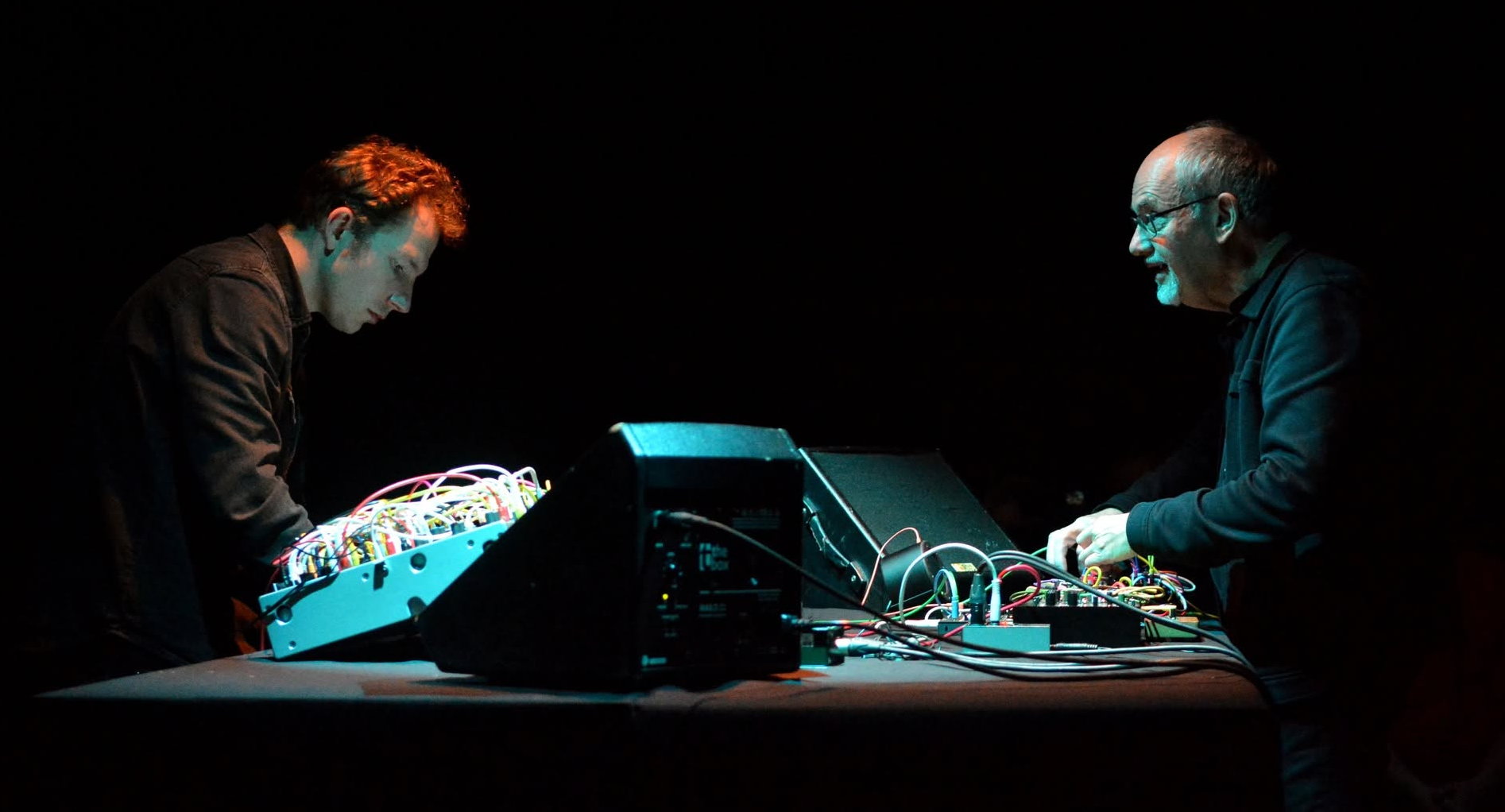
Karlheinz Essl and Otto Wanke started their musical collaboration as performers in 2025 at a concert in Brno (CZ), although they have known each other for many years - Otto was a student of Karlheinz at the University of Mucis and Performing Arts Vienna (mdw) and graduated there in 2018. Each of them plays his own self-configured electronic instrument based on various non-standard analog synthesizer modules. Using non-linear analog feedback loops, they create ever-changing and modulating sounds that constantly shift into new, often unpredictable musical contexts.
Their improvisational musical interaction involves spontaneous communication between themselves and their electronic devices. They see their music as an ever-changing process that constantly creates new situations. Essl and Wanke embrace the surprising possibilities that arise when noise, sound spectra and chaotic systems merge into immersive soundscapes. These are sometimes projected through a multi-channel loudspeaker system, giving their musical dialogue a distinct spatial dimension and immersing the audience in a vivid world of sound.

Los Modulinos live at Divadlo na Orlí
Brno, 6 Feb 2025
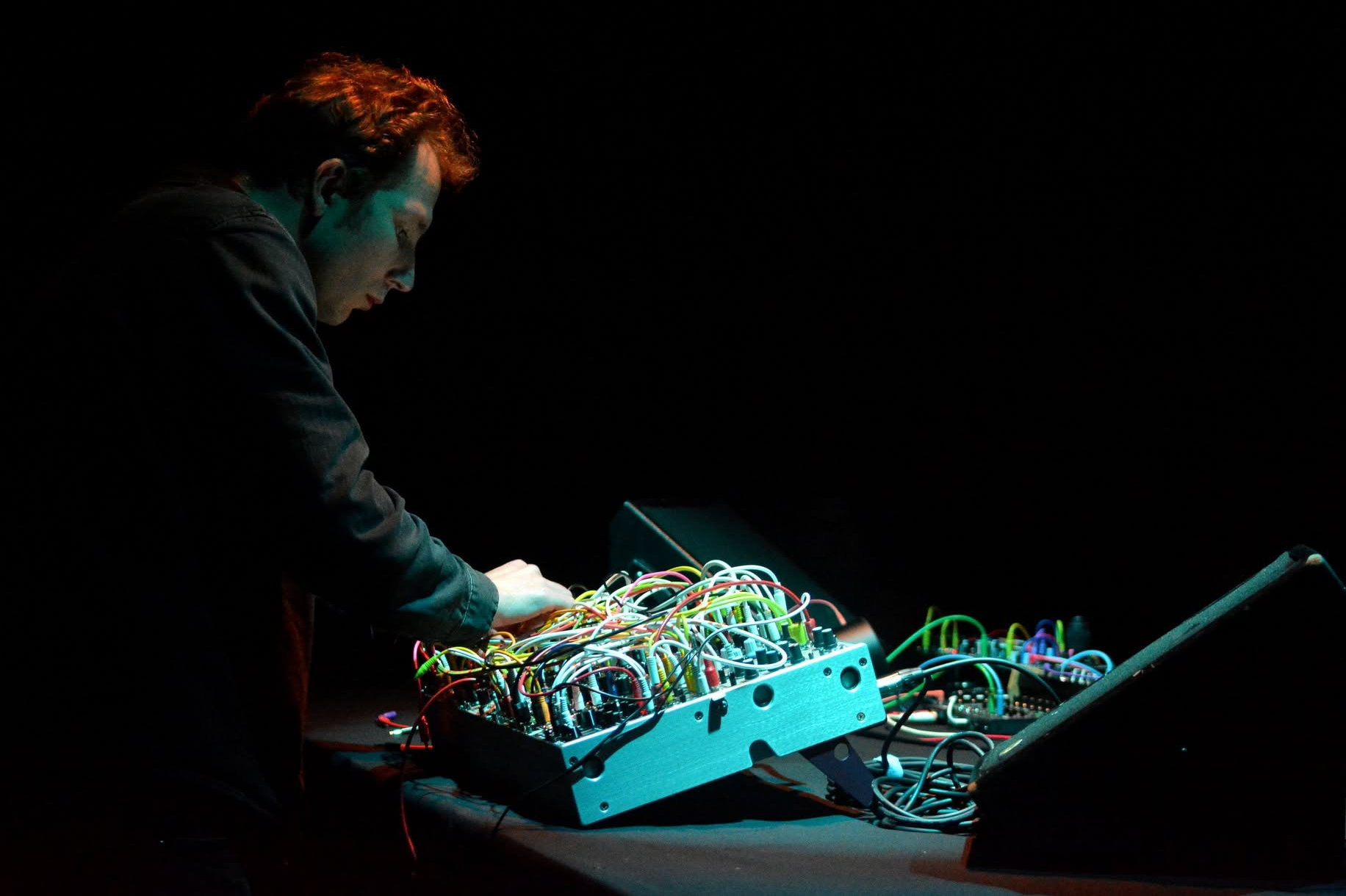
Otto Wanke
Karlheinz Essl (b. 1960) is an Austrian composer, performer, improviser, software developer, media artist and composition teacher. He studied composition in Vienna with Friedrich Cerha and completed his musicology studies with a doctorate on Anton Webern. Composer-in-residence at the Darmstadt Summer School (1990-94) and at IRCAM in Paris (1991-93). From 1995-2006 he taught algorithmic composition at the Bruckner University in Linz. Since 2007 he has been a Professor of Composition and Electroacoustic Music at the University of Music and Performing Arts in Vienna. Between 1992 and 2016 he was music curator at the Essl Museum in Klosterneuburg.
His work with computers and a long-term preoccupation with the poetics of serial music have been formative influences on his compositional thinking. During the 1990s he carried out various projects for the Internet and became increasingly involved in improvisation. In 1997 Karlheinz Essl was a featured composer at the Salzburg Festival.
In addition to writing instrumental music, Karlheinz Essl also works in the areas of electronic music, interactive real-time compositions and sound installations. He develops software environments for algorithmic composition and live electronics.
As a performer and improviser he plays his own computer-based composition environments as well as instruments such as toy piano, electric guitar, modular synthesizers and analog electronics.
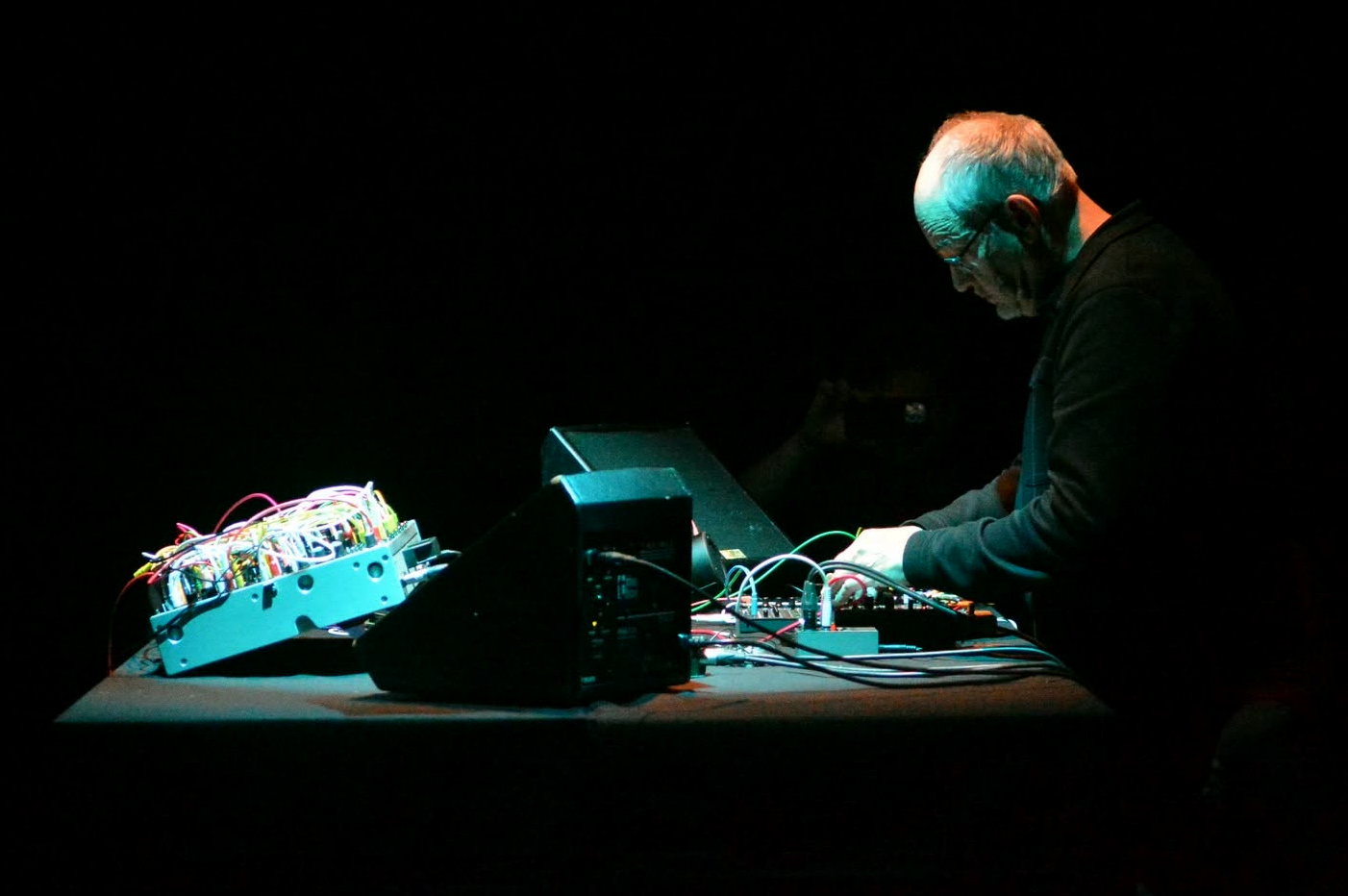
Karlheinz Essl
Los Modulinos live at Blue Mountain Contemporary Art
Vienna, 11 Feb 2025
Los Modulinos live at Divadlo na Orlí
Brno, 6 Feb 2025

Karlheinz Essl's modular setup

Otto Wanke's modular rack
Wanke’s opening solo emerged from silence through bubbling, crackling sounds, which gradually gained rhythmic density as they looped. These were disrupted by high-pitched resonances and a sustained note in the mid-range. Rapid arpeggios contrasted with slower soundscapes, whilst equalisation filters and echoes altered both the timbre and the decay of individual notes. Some sounds pulsed in short loops, whilst others lingered in the space. At times, a steady, almost dance-like rhythm emerged, along with hints of a melodic structure. Wanke worked sensitively with dynamics and the layering of sounds, concluding the piece with a motif reminiscent of its opening.
Otto Wanke and Karlheinz Essl live at MusicOlomouc (26 Oct 2026)
In the first joint section, a distorted bass line joined the high-pitched tone, creating a dense sonic layer. The pulsating motif underwent transformations through equalisation, dynamics and overtone resonances. At times, the loops created a regular rhythm into which other motifs were woven. I often had the impression that Wanke was shaping the rhythmic foundation whilst Essl led the main voice. However, their roles gradually blended, and long soundscapes alternated with rapid, staccato motifs. The acoustics of the theatre hall ensured clarity even during heavily distorted passages.
Essl’s solo began with a high note, the overtones of which gradually grew stronger and then faded. This created a sustained soundscape that varied primarily in timbre and intensity. Into this entered arpeggios and pulsating loops with a more pronounced rhythmic structure. Essl sensitively nuanced the dynamics and gradually traversed a broad sonic spectrum, from rich, deep basses to almost shrill high notes. Some of the arpeggiated passages reminded me of specific melodic motifs that emerged from an otherwise abstract stream of sound.
The concluding joint section began with a crackling pulsation in the low frequencies. The distorted sound initially came across as almost jarring, but its individual layers gradually revealed themselves. Both musicians simultaneously varied pitch, dynamics and spectral colour. Wanke’s rhythmic impulses intertwined with Essl’s lines, which at times had a surprisingly melodic quality, and their roles were less distinct than in the previous joint section. The high notes took on an almost luminous quality, and recognisable melodic contours occasionally emerged in the arpeggios. The contrasts between the bright highs and the rich bass maintained the tension right to the end. ‘On the Threshold’ particularly captivated me with the variability of its sound layers and its sensitive handling of resonance, overtones and dynamics. Both concerts demonstrated how differently one can approach sound, time and repetition. *Time Flash* appealed to me with its thoughtful alternation of moods, motifs and melodic-harmonic structures, whilst *On the threshold* led me to a more focused listening to the sound texture itself. From the chapel, I took away melodic fragments and the contrasts between the pieces; from the theatre, a memory of sounds whose transformations unfolded right before the listener’s eyes. For me, the common thread remained the attention to detail and the ability to keep the listener in suspense even without a traditional melodic line.
L’evento musicale dei Los Modulinos tenutosi l’11 febbraio ha raccontato una storia di casualità e creatività. Nonostante la collaborazione dei due compositori sia abbastanza recente, Essl e Wanke hanno saputo trovare una perfetta intesa instaurando un dialogo musicale continuo.
La performance, divisa in due parti scandite da un breve intervallo, ha catturato l’attenzione del pubblico per tutta la serata offrendo agli spettatori un’esperienza unica, fatta di affascinanti sperimentazioni sonore date dalla manipolazione del suono in tempo reale. La libera improvvisazione dei due musicisti, basata sull’interconnessione e sulla loro personale sensibilità, ha infatti dato vita ad una sinfonia di suoni spettrali, caos e rumore, capace di condurre il pubblico attraverso paesaggi sonori sconosciuti e offrendo un’esperienza nata durante la performance stessa.

Otto Wanke and Karlheinz Essl live at BMCA Vienna (11 Feb 2025)
© 2025 by Georg Herder
Alle loro spalle, l’ampio dipinto di Huang Min 黄敏 (*1975), Untitled, ha contribuito a valorizzare le suggestioni di molteplicità ed eterogeneità suggerite dal vortice dei suoni.
L’entropia dei toni iniziali ha assunto gradualmente le sembianze di melodie elettroniche dagli accenti grotteschi, futuristici e quasi alieni, proprio come echi di un linguaggio e di una dimensione non più umana. Nella seconda parte, invece, ad un’inizio di suoni gravi, interrotti e frammentati, ha fatto seguito un crescendo di acuti, poi dolcemente affievoliti, a creare un’equilibrata armonia tra suoni e silenzi.
La live performance dei Los Modulinos, in conclusione, ha intessuto sequenze sonore capaci di narrare una dimensione dove il caos è origine di creazione e creatività. Le trame musicali generate dai due compositori hanno coinvolto il pubblico, chiamato a recepire stimoli nuovi, emozioni continue e differenti: un processo capace di aprire in ciascuno nuovi soggettivi orizzonti sonori, una performance creativa in grado di generare creatività nei componenti del pubblico.
In electroacoustic music, this understanding has been further deepened, amongst other things, by the possibility of intervening in the microscopic structure of sound: in his essay …wie die Zeit vergeht… (Stockhausen 1957), Karlheinz Stockhausen characterises music as a ‘modulation of time’, whilst pointing to the interconnection between the various parameters of music: rhythm, pitch and timbre can all be understood as manifestations of the same temporal dimension. This approach allows us to perceive the continuity of time scales – from the milliseconds that determine timbre, through the seconds that shape rhythmic or melodic patterns, to large-scale structural and formal units.
This concept is further developed by spectral music, in which parametric interaction and ambiguity are taken a step further. Gérard Grisey emphasises that sound is not merely a physical phenomenon, but above all a process of perception, and speaks of a ‘Copernican revolution’ in musical thought: music does not merely operate within time, but actively creates time itself – that is, our experience of it and our perception of it (Grisey 2000).
Building on this context, the duo Los Modulinos explores the phenomenon of time through non-linear feedback processes, which are particularly pronounced in analogue electronic instruments. Even minimal time shifts or slight changes in circuits can lead to radical transformations of sound structures and to the creation of new perceptual horizons. Feedback loops serve here as tools that demonstrate how complex and dynamic musical structures can develop from imperceptible temporal deviations. This principle applies at various temporal levels: from extremely short single-sample feedback loops, which form the basis of a range of sound processes (from filters and oscillators to non-linear and chaotic systems), to longer recursive loops. In the spirit of Heinz von Foerster, who argued that the feedback process "transforms a trivial machine into a complex one", compositional strategies are thus created that interlink the technical logic of synthesiser circuits with the ever-changing experience of time itself.
Updated: 30 Oct 2026