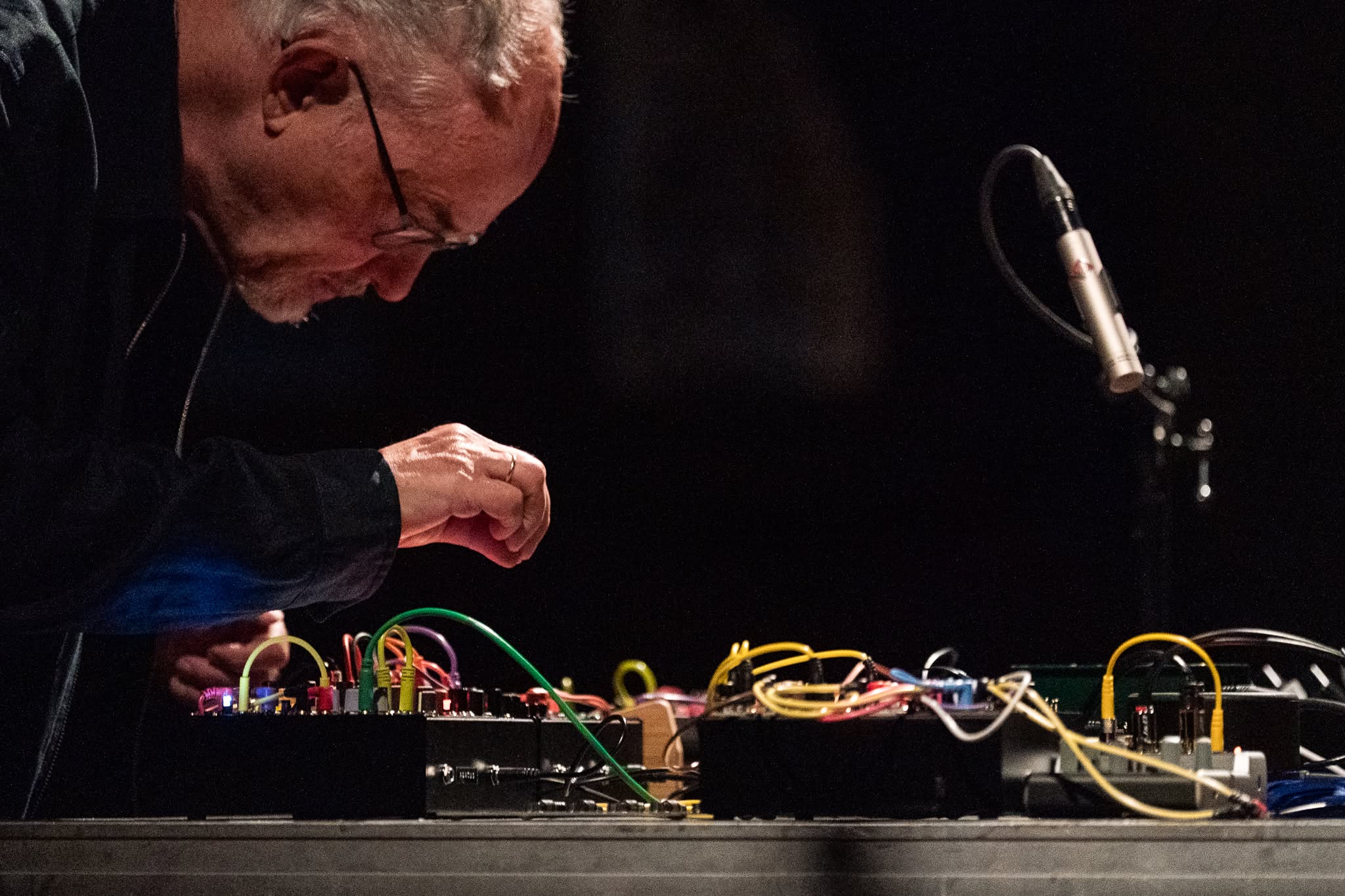
Photo © Jan Prokopius
in: Klasika Plus (7 Oct 2026)
The Music, Mind and Machine concert at the Besední dům on October 5th, organized by the Brno Philharmonic as part of the New Music Exhibition, juxtaposed various ways of working with live electronics. Karlheinz Essl presented four world premieres for modular synthesizers, and Franciszek Araszkiewicz, in the Deep Thought project, also incorporated brain activity into the sound as part of a biofeedback performance.
Photo © Jan Prokopius
The evening began without a single word. In the darkened Besední dům, only Karlheinz Essl's table with electronics and modular synthesizers remained illuminated. The author bowed and, instead of explaining, let the first note that emerged from the silence in Doing Math speak. Essl treated it as a physical object – letting it pass through space, increasing its frequency and awakening the resonances of the overtone components. The note was thus not a static material, but a source of further sound events. Slow changes made it possible to perceive the differences between the fundamental frequency and its resonant components; the subsequent expansion into the bass spectrum further destabilized this originally rather homogeneous material.
Essl did not really work with sound or tone as a pitch value intended for melodic development, but as an acoustic material that can be transformed into diverse sonic surfaces. In Coastline extended, the author developed the same principle in a somewhat more layered manner. From the deep bass base, the mid and upper spectrum gradually opened up through resonances; one surface was approached by another, differently colored one. The tones of the synthesizer, which I associate with an arpeggiator, sometimes indicated a more regular structure. The later distorted passage with beats and irregular impulses sounded all the more striking to me - after the previous staticity, it seemed like a formal break, not just a change in dynamics. The following high tones again transformed the character of the sound space and created a contrast to the previous density - the author thus kept the listener in constant tension.
Essl did not really work with Loplop was the closest of Essl's compositions to the more traditionally perceived formal articulation. Static pulsation here acquired a kind of rhythmic function in places, and a whistling synthesizer and short pulses appeared above it. Ticking, pulsation and whistling returned in various combinations, so that it was possible to follow their relationships almost as if working with motifs.
The composition Foldinger, on the other hand, once again turned attention to the transformation of sound matter. Higher overtone components emerged from the deep vibration, and aggressive, noise-like sounds resembling mechanical friction penetrated them. Essl made significant use of filters and equalization here; without having to fundamentally change the basic tonal position, the distribution of energy between frequency bands changed. Accelerated pulsations in places acquired an almost glitchy character and created strong tension. In addition, moments of silence in the final periods functioned as a form-forming contrast to the previous high dynamics.
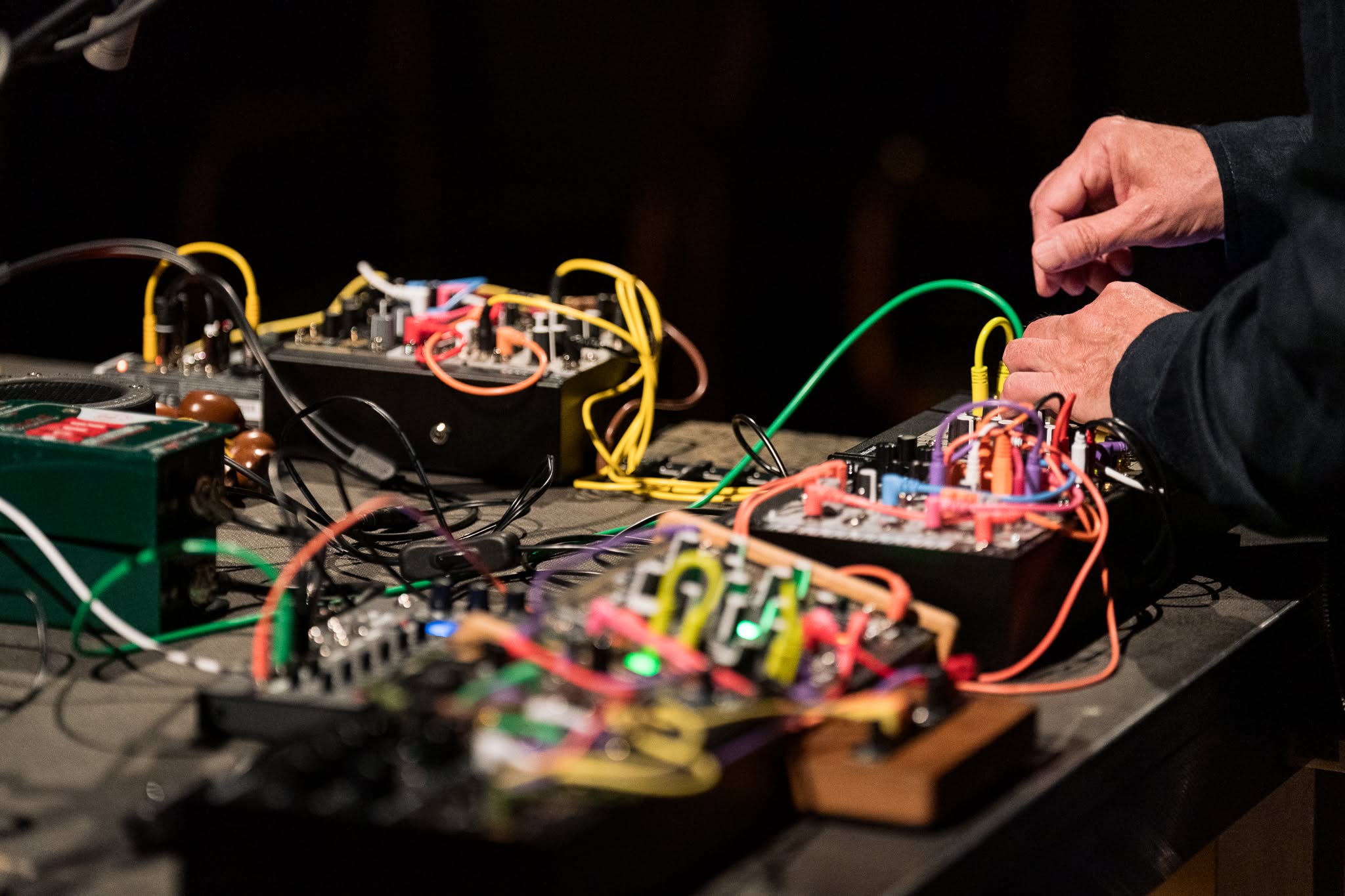
Photo © Jan Prokopius
After the performance of Franciszek Araszkiewicz, he and Essl embarked on a short improvisation together. The initial hum gradually developed into an intense sound gradation, alternating long areas with sparkling impulses and cutting noises in the midrange. The sound simultaneously changed in space and created the impression of movement between individual parts of the hall. The result for me was not a demonstration of two technologies, but their immediate confrontation. Essl concluded by mentioning that this was the first time the authors had played together like this.
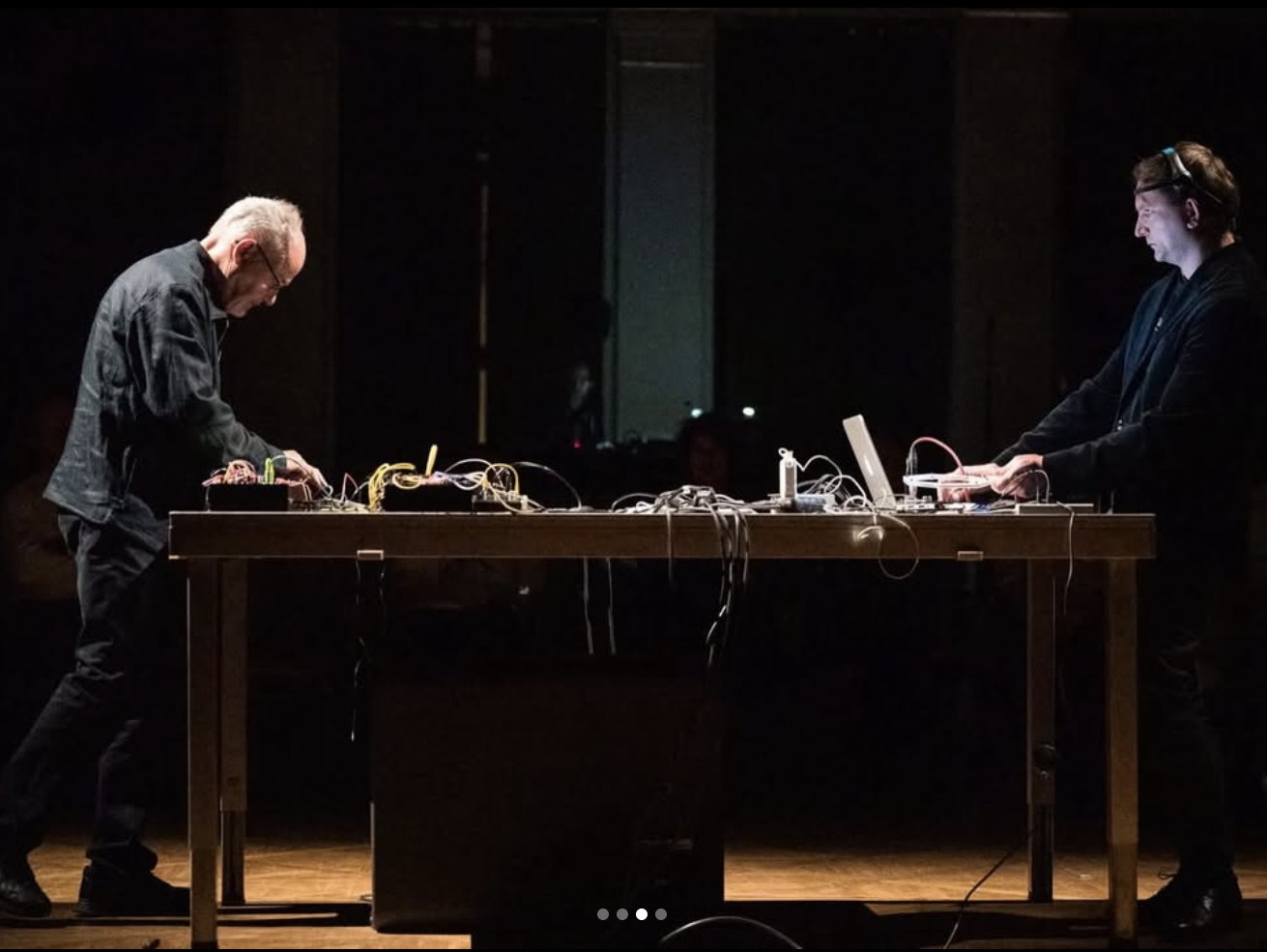
Photo © Jan Prokopius
The Music, Mind and Machine concert showed several possible forms of electronic compositional thinking – from Essl’s systematic work with the frequency spectrum, through the rhythmization of pulsating material, to Araszkiewicz’s connection of sound with physiological signals. Therefore, what I took away from the concert was not the idea of electronics as a replacement for traditional instruments, but as a means that allows us to determine and compose the very physical properties of sound – frequency, density, color, movement, and spatial location.
---
Martin Janečka is a musicologist, educator, singer and multi-instrumentalist, publicist and sound engineer.
| Home | Works | Sounds | Bibliography | Concerts |
Updated: 27 Jan 2026