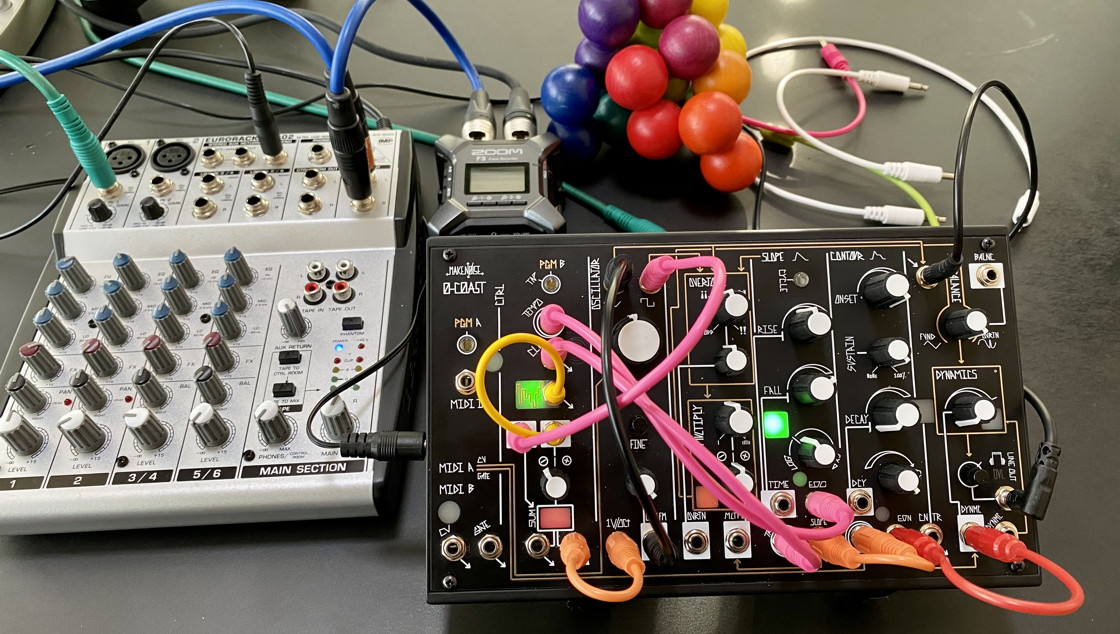
Setup for Coastlines
Otto Wanke
Program book of the festival ARS SPECTRUM
Filharmonie Brno, 2026
Karlheinz Essl (born 1960) is one of a group of composers who have significantly expanded the possibilities of algorithmic and computer-assisted composition since the 1980s. He started by developing his own programming tools for the Atari ST, and while working at IRCAM in Paris in the early 1990s, he transferred them to the Max environment, gradually building them into the Real Time Composition Library (RTC-lib). Through this library, Essl worked with generative models and controlled randomness. This allowed music to emerge not as a reproduction of a fixed score, but rather as something that was created directly at the moment of its performance.
An important influence on Essl's thinking was the work of Gottfried Michael Koenig (1926-2021), who viewed serialism and aleatoric music as two extremes of a continuum between determination and chance. This tension is also reflected in Essl's instruments, where the algorithm is not merely a means of automation, but a means of composing the field of possibilities, balancing predictability with open, statistically controlled processes. This line of thinking creates a surprising continuity with Essl's current inclination towards analogue instruments.
After decades of working with computers, he began experimenting with modular synthesizers and configuring his own analogue systems in 2022. In the Coastlines project, he connects the individual modules of this synthesizers to create non-standard feedback networks whose interdependent parameters generate non-linear systems operating on the border between stability and chaos. Therefore, the resulting sound cannot be simply programmed or precisely replicated. Instead, the performer must constantly balance the system and respond to its transformations — even the slightest intervention can radically alter the behaviour of the whole system. Here, feedback is not merely a sound effect, but a principle that interconnects individual control signals and enables the emergence of complex and partly unpredictable states.
Setup for Coastlines
The title Coastlines also refers to the mathematical paradox of the coastline: the closer we examine it, the more irregularities and details we see, and the more accurate our measurements become, the longer its calculated length grows. A similar principle can be found in Essl's treatment of sound. Rather than focusing on individual tones, Essl focuses on their internal structure – a continuum between pulse, pitch, spectrum and noise, which can be observed across various temporal scales. In this context, Essl recalls Stockhausen's conception of rhythm, pitch, spectrum and form as related temporal phenomena. In his article ...wie die Zeit vergeht, Stockhausen demonstrates that the boundary between these categories is not absolute. A sufficiently accelerated sequence of individual pulses, for example, ceases to be perceived as rhythm and merges into a stable pitch. Meanwhile, the specific shape of the oscillation determines the spectral composition, and thus the timbre, of the resulting sound. Rhythm, pitch and timbre are therefore not separate parameters, but different manifestations of a temporally organised process that unfolds on different temporal planes. For spectralism, this continuous conception is particularly important in linking the internal temporal relationships of sound with rhythm and form and allowing all these levels to be considered as permeable scales of sonic events.
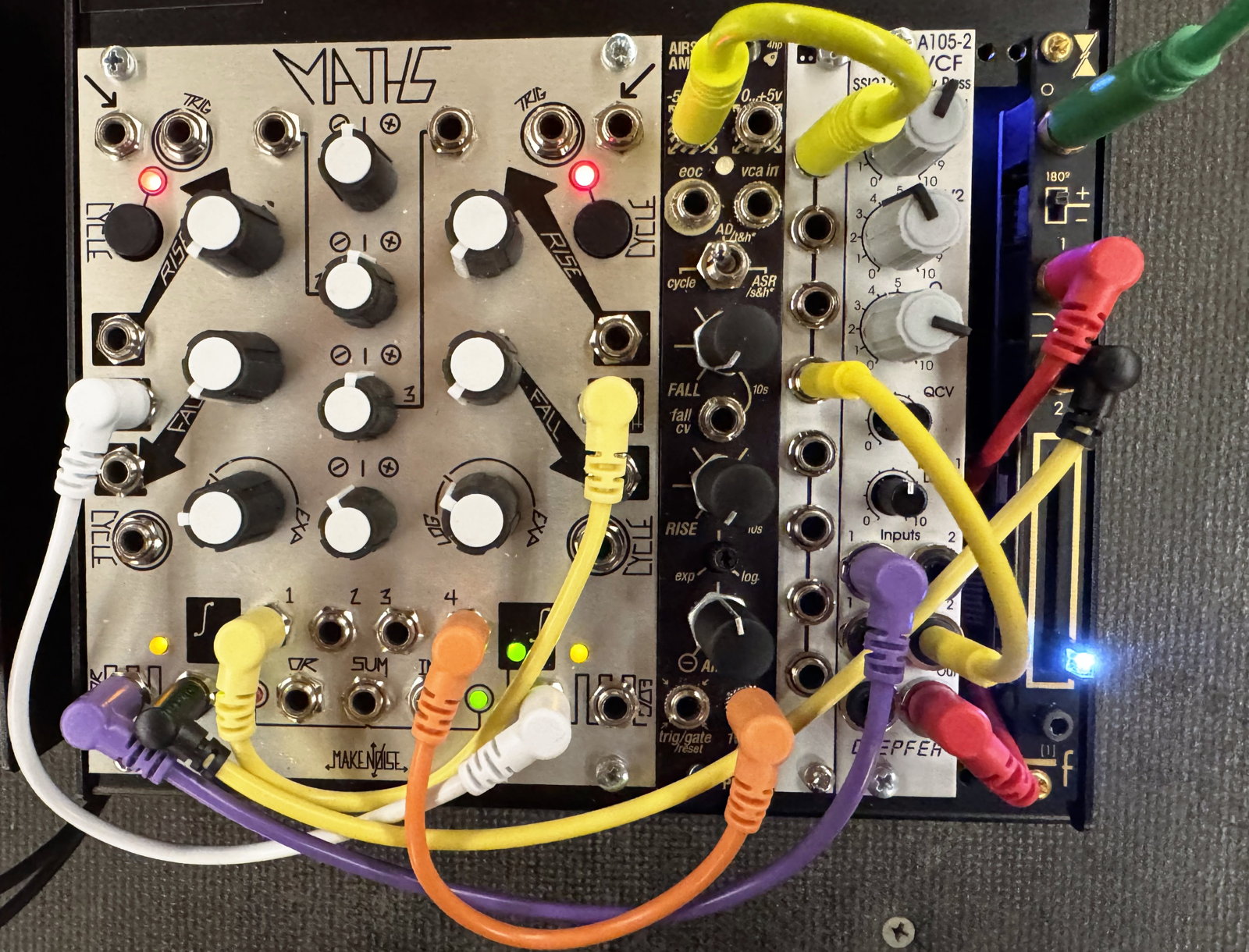
Setup for Doing Math
This concept is further developed in the Doing Math series, which focuses on the Make Noise Maths analogue function generator. Its significance lies in the fact that it is not limited to a specific musical function. Building on the tradition of multi-purpose function generators such as the Serge DUSG, depending on how it is wired, it can generate, process and mix control or audio signals. It can create an envelope, periodic modulation or portamento; in cyclic operation, it can also function as an oscillator. This function articulates a waveform or rhythmic period on a slow timescale; when accelerated, it shifts into the realm of pitch, consequently influencing the spectral structure of the sound. This is precisely where Stockhausen's concept of a common temporal basis for rhythm, pitch and spectrum takes on a concrete technical form. The distinction between rhythmic, melodic and timbral modules becomes irrelevant: the same function can be transferred between different timescales, and its musical significance changes with the speed and manner of interconnection.
Essl discovered another way to utilise feedback in no-input mixing. In this technique, the mixing desk receives no external sound source; instead, its outputs are fed back into its own inputs, effectively turning the equipment into a sound generator. Even the slightest movement of a fader or change in equalisation can set the emerging network in motion, destabilise it, and transform it into a new sonic state.
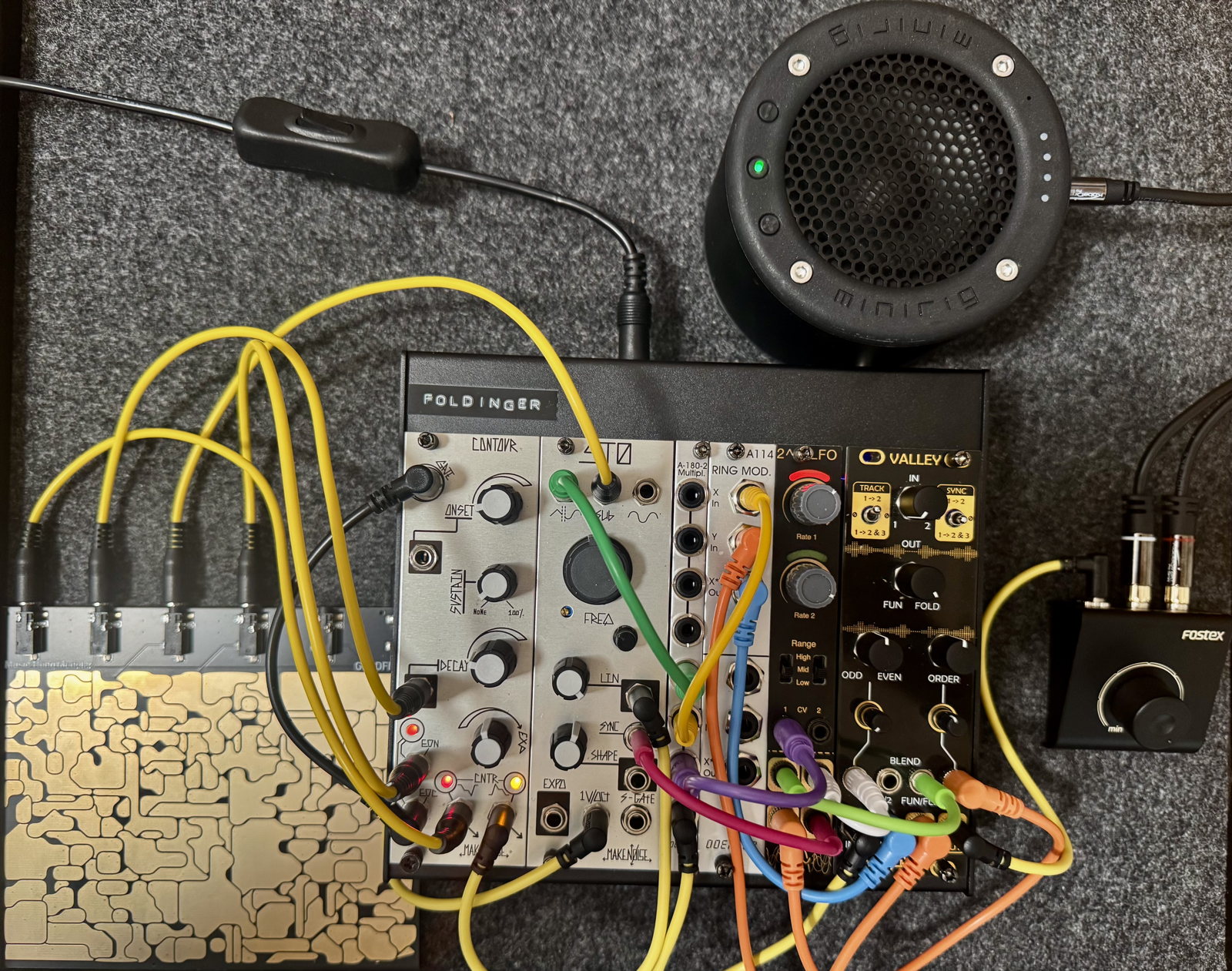
Setup for Foldinger
In his piece Foldinger, the focus on the autonomous behaviour of the electronic system brings us closer to the physical materiality of sound. Here, Essl connects his modular instrument to two small loudspeakers and further shapes their sound using metal tea caddies and seashells. Depending on their position, these objects act as acoustic filters, sources of distortion or resonators. Electronic synthesis therefore does not end at the speaker's output; it continues in the mechanical vibrations of specific objects whose material and resonance become another component of the instrument.
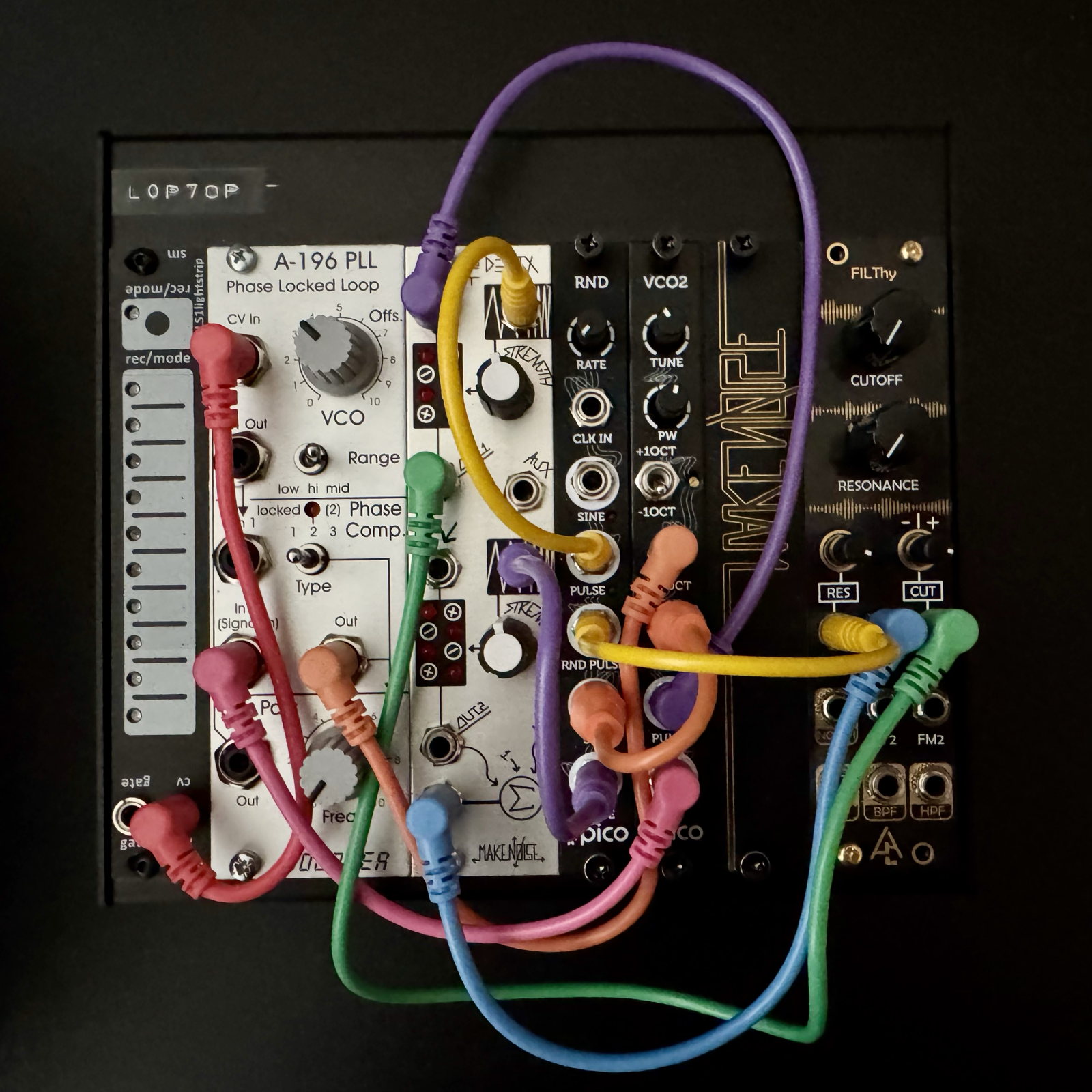
Setup for Loplop
Loplop is another example of Essl's experimentation with modular electronics. The title refers to a bird-like mythical figure created by the surrealist painter Max Ernst as his alter ego. Drawing on this motif, Essl explores his fascination with bird calls by constructing a minimalist instrument designed to enable electronics to sing, chirp or erupt in a manner akin to an imaginary avian organism. Consisting of just a few elements — a phase-locked loop, a random generator, an oscillator and a resonant filter — the system's intense cross-modulations and feedback loops produce surprisingly complex sonic behaviour. Thus, a unique electronic organism emerges from just a few elementary circuits.
| Home | Works | Sounds | Bibliography | Concerts |