
Prendere il Fa
per organo2021
Dedicated to Wolfgang Kogert
Dedicated to Wolfgang Kogert
Prendere il Fa (2021) performed by Wolfgang Kogert
Track from the album ORGANO/LOGICS (col legno 2023)
Recorded at Hofmusikkapelle Wien
Glasklare Form, kristalline Klänge.... ein Stück, das in seiner Reduktion der Mittel entfernt den Geist alter Ricercari atmet. Karlheinz Essl ist mit seinem neuesten Werk Prendere il Fa ein weiteres Zeugnis seines kreativen Zugriffs auf das Instrument Orgel gelungen: Stete Tempoveränderungen und dynamische Entwicklungen bestimmen den schwebenden Charakter, hinter dem sich elegant die vielschichtige – und letztlich strenge – Konstruktion der Tonhöhen und -Dauern verbirgt.
Vielleicht wohnt dem kompakten Stück auch deswegen eine solche Leichtigkeit inne, weil es ohne konkreten Anlass, einfach aus Karlheinz Essls und meiner Freude an unserer kontinuierlichen Zusammenarbeit und Experimentierlust, entstanden ist.
Für die Wiedergabe ist eine Orgel mit einem oder mehreren sehr effektiven Schwellwerken notwendig. Bei der Uraufführung an der großen Rieger-Orgel in St. Martin in Kassel während des Festivals BRANDNEU habe ich sehr obertonreiche Registrierungen gewählt, um dem hellen Charakter des Werkes gerecht zu werden. (Wolfgang Kogert, 8.9.2022)
Wolfgang Kogert playing the première of Prendere il Fa
Festival BRANDNEU - St. Martin, Kassel (D)
3 Sep 2022
Video: Karlheinz Essl
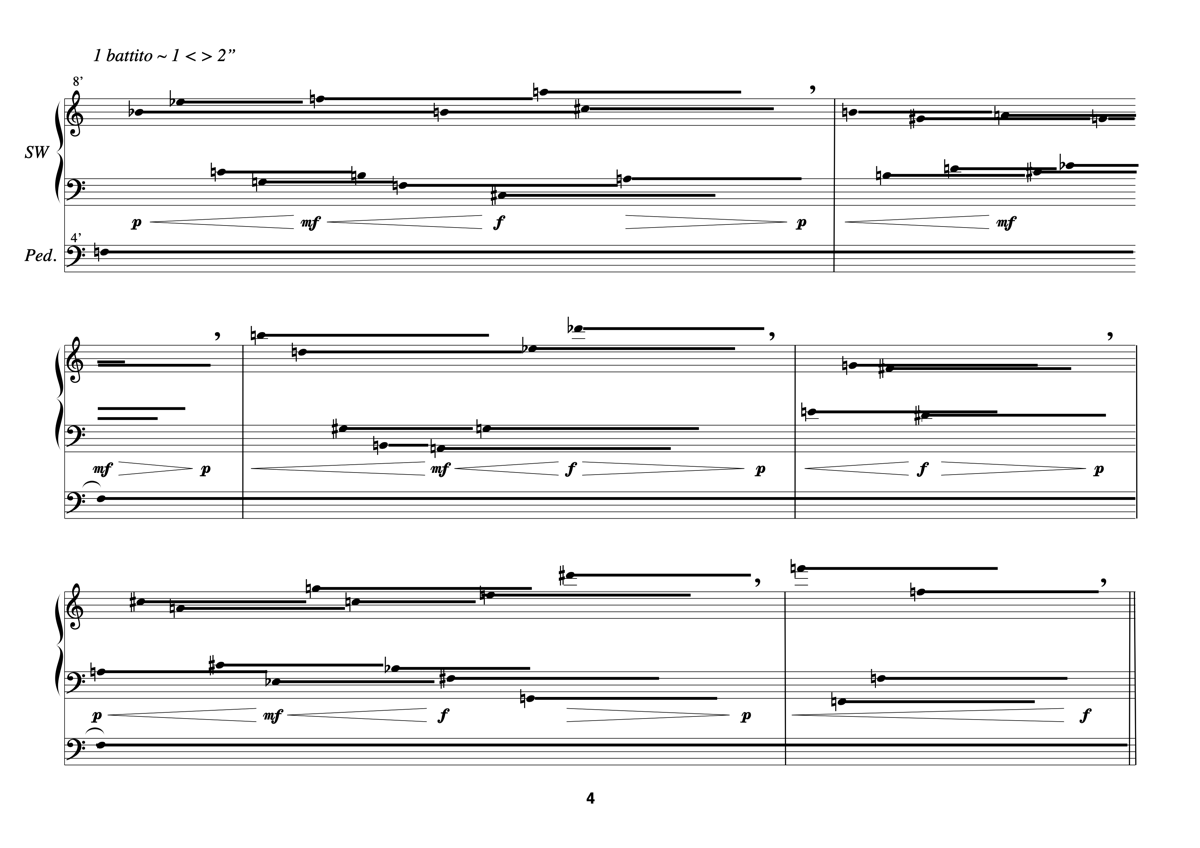
Prendere il Fa, p. 4
© 2021 by Karlheinz Essl
Prendere il Fa, analysed by Willyn Whiting
2026
And if we look at it, we see some interesting stuff: multi-layered beaming across all three staves, shifting in tempo between eighth equals fifty and eighth equals four hundred. It's just kind of fluctuating and the bottom note of each one is articulated by the pedal.
The figuration changes. Eventually we get these sustained things in the middle and then we're back to the A section. So it seems short with a pretty straightforward form: crystal clear shape and sound, a piece that, in its reduction of means, distantly breathes the spirit of old Richard Carey.
And now quoting Wolfgang Kogert who commissioned this piece:
With his latest work, Prendere il Fa, Karlheinz Essl has succeeded in providing further testimony to his creative approach to organ as an instrument, constant tempo changes and dynamic developments. Determine the floating character behind which the multi-layered and ultimately strict construction of pitches and durations is elegantly concealed. Perhaps this is why the compact piece has such a lightness, because it is created without a specific reason, simply out of Essl's and my joy in our continuous cooperation and desire to experiment.(...) This idea of slowing and speeding up and these harmonies that like end up converging on like a F unison - that is something that we've already seen in Essl's music. We looked at his piece Trois Cent Notes, which was for either vibrophone or piano or toy piano. I think we looked at it in the percussion series, so as a vibraphone piece.For reproduction, an organ with one or more very effective swells is required. The premiere was performed on the large Rieger organ in St. Martin in Kassel, Germany. I chose registrations that are very rich in overtones in order to do justice to the bright character of the work.
But it's a it's exactly the same idea just in a different context. So in that former piece it's sort of the monothematic, like the main idea. Here it's the main idea in an A section and then there's this B section that is completely different in terms of material.
Also, a a new thing with this one is the there's this idea of the bottom note of the filigree figure like ascending slowly. That's a really effective thing. It also like goes back down and descends, so it creates this like arch. Which complements the swelling of dynamics. It's all very like straightforward and um you can even see the piece in the waveform itself.
The A section has these three swells that and they come back later, maybe in reverse order, just based on what I'm seeing here. The first one is a little bit longer, as is the last one here, so maybe it's like reversed. And then in the dead center you have these other swells. And they probably follow some pattern as well that's easy to figure out.
And this whole middle section's on an F drone which I think is really interesting. The piece has this sort of central pitch that everything is oriented around.
| Home | Works | Sounds | Bibliography | Concerts |
Updated: 25 Mar 2026